

USCIS Advances Gold Card Program: What High-Net-Worth Immigrants and Employers Need to Know
The long-anticipated U.S. “Gold Card” program took a major step forward this month. On November 20, 2025, U.S. Citizenship and Immigration Services (USCIS) submitted Form I-140G, the petition for the Gold Card program, to the Office of Management and Budget (OMB) for federal review. This submission is a required step before USCIS can open the program for filings, and it signals that implementation is actively underway.
Below is a breakdown of what we know so far.
Quick Recap: What Is the Gold Card Program?
The Gold Card program is a new U.S. immigration pathway designed for extraordinarily accomplished individuals and certain qualifying employers willing to make a substantial financial “gift” to the U.S. government.
Unlike EB-5, which is investment- and job-creation-based, the Gold Card program is built on the existing EB-1A Extraordinary Ability and EB-2 National Interest Waiver (NIW) frameworks.
Key Requirements Under the Proposed Framework
Contribution Amounts
Current agency guidance and industry reporting indicate:
$1 million non-refundable gift for individual applicants
$2 million gift for corporate petitions (principal applicant)
+ $1 million gift per dependent under a corporate petition
USCIS filing fee of approximately $15,000 per applicant
These contributions are structured as “gifts,” not investments, and would not be returned if a petition is denied.
Merit-Based Eligibility Still Appears to Apply
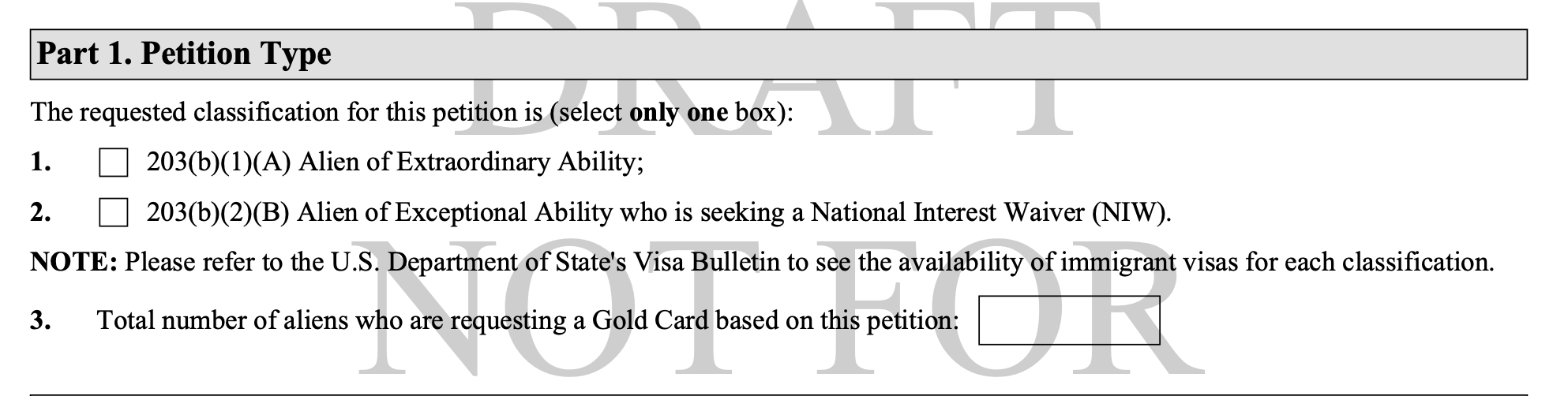
Proposed Form I-140-G
The Executive Order provides that the qualifying gift “shall be treated as evidence of eligibility” for two existing employment-based immigrant visa categories:
EB-1A Extraordinary Ability (8 U.S.C. § 1153(b)(1)(A));
Exceptional ability and national benefit (8 U.S.C. § 1153(b)(2)(A)); and Eligibility for a National Interest Waiver (8 U.S.C. § 1153(b)(2)(B)).
However, the Administration has not issued any implementing guidance explaining how this evidentiary treatment will operate or what weight adjudicators will give it. It remains unclear whether the gift will serve as supplemental evidence or whether it will be treated as carrying presumptive significance in meeting EB-1A or NIW standards.
This section of the proposed I-140G (pictured above) is not clarifying.
Notably, the Executive Order also does not address how the Gold Card would interact with the Department of State’s Visa Bulletin, including whether participants could receive priority-date advantages or otherwise bypass the longstanding backlogs in EB-1 or EB-2. At this stage, there is no indication that Gold Card holders will be able to “jump the line,” and it remains uncertain how DHS or DOS could fast-track visa issuance within these existing statutory categories without creating new visa numbers or a separate classification. We will be watching these developments closely.
Source-of-Funds Requirements
Applicants will face heightened transparency requirements, including:
Verification of domestic and foreign bank accounts
Documentation of crypto holdings and transfers
Proof of lawful source of funds for all gift amounts
Potential reporting obligations for corporate officers involved in gifting decisions
This level of scrutiny appears stricter than traditional EB-5 requirements and is expected to be a major part of the eligibility review.
Program Timing and Launch Date
The program is not accepting petitions yet. The filing of Form I-140G with OMB indicates the process is moving forward, but several steps remain:
OMB review
Publication of final form instructions and regulatory guidance
Announcement of filing logistics (adjustment of status vs. consular processing)
Clarification of dependent rules and corporate sponsorship procedures
The Administration has publicly indicated a target launch date of December 18, 2025, though this may shift based on regulatory timelines.
Why the Gold Card Matters
For High-Net-Worth Individuals
The Gold Card may offer:
A faster, more predictable path for individuals with extraordinary records
A new option for entrepreneurs, technologists, researchers, and global executives
A way to leverage holistic achievements when traditional O-1/EB-1A evidence is strong but borderline
However, the financial commitment is substantial and non-refundable. Early planning for tax implications, banking pathways, and source-of-funds evidence is critical.
For Companies Considering Sponsorship
Corporate-sponsored Gold Card petitions may benefit:
Senior executives
Founders
Key technologists or researchers vital to corporate strategy
But employers must navigate corporate governance, fiduciary duties, gift-approval procedures, and documentation burdens.
Our Firm’s Perspective
From our perspective as former USCIS attorneys with extensive EB-1A and NIW experience, the Gold Card may offer a promising option for certain high-achieving individuals. But the program’s substantial financial commitment, the still-unclear evidentiary framework, and the absence of agency guidance mean this pathway requires a thoughtful and nuanced strategy review before proceeding.